





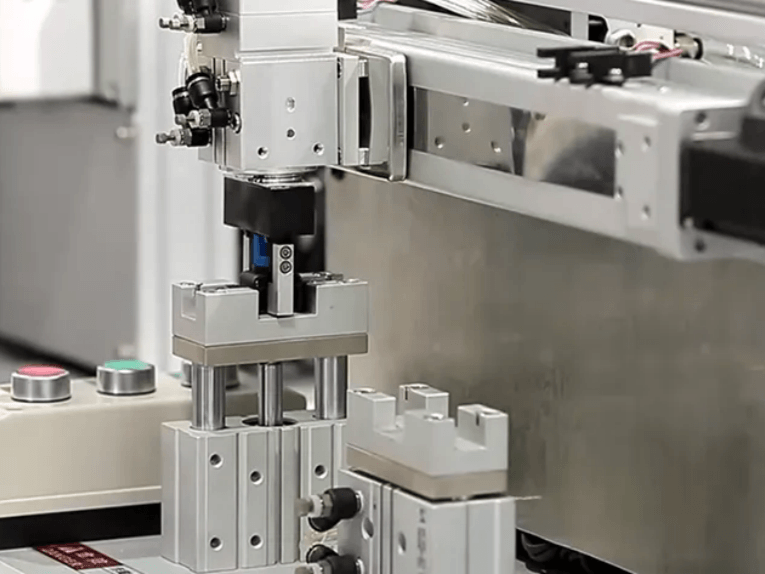
1. PNEUMATIC CYLINDERS
Using the fluid power, the movement of many work elements is ensured. Pneumatic cylinders use the power of air as a fluid. They constitute the linear motion part of the basic circuit elements in pneumatic systems.
Pneumatic cylinders are the most widely used cylinder types today. The variety of products is great, accessibility is easy. They work very well in working condition between the starting and ending positions of the cylinder. Their working force range is wide and they are fast. They are clean systems.
Pneumatic cylinders have some disadvantages as they use air as a fluid. Air is a compressible fluid. For this reason, positioning accuracy of pneumatic cylinders is not good. Speed and force control cannot be done properly. Although they have low investment costs, they have high operating expenses.
2. HYDRAULIC CYLINDERS
Another system that takes advantage of fluid power is hydraulic systems. Hydraulic cylinders use the power of fluid as a fluid. They constitute the linear motion part of the basic circuit elements in hydraulic systems.
Hydraulic cylinders are preferred where high power is required. Oil is generally used as a fluid. Since the liquid fluid is incompressible in these systems, the positioning accuracy of the hydraulic cylinders is better than the pneumatic cylinders. Speed control and force control capabilities are also better than pneumatic cylinders. Hydraulic systems are complex, dirty systems. Its projecting requires good engineering.
3. ELECTRIC CYLINDERS
Electric cylinders are separated from other systems and have a mechanical structure. Movement is provided by a screw shaft placed in a body. The ball screw enables power transfer by converting the circular motion it receives from the motor to linear motion. Depending on the mechanical products used in electric cylinders and the type of engine, high position precision, speed control and force control are provided.
SUMMARY:
The basic logic of electric cylinders is to provide useful work by converting the rotary (circular) motion of a drive element to linear (linear) motion. The models of electric cylinders differ according to the type of motor that will provide rotational motion, the type of screw shaft that will provide linear movement, and the connection types that allow these two components to be combined.
Electric cylinders are often compared with pneumatic cylinders due to their application areas. This comparison can sometimes be done with hydraulic cylinders. All three systems have advantages and disadvantages according to their characteristics. Users should consider these issues while choosing products for their application.
Electric cylinder: It is used in machine manufacturing, automotive and automotive sub-industry, food, textile, packaging and packaging, health devices, test devices, robotics and electronics applications.
Post time: Jun-02-2026