





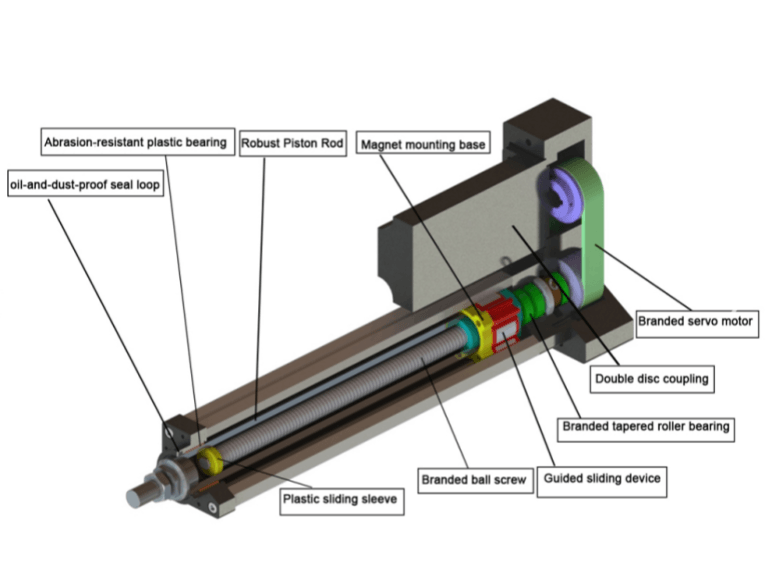
The basic logic of electric cylinders is to provide useful work by converting the rotary (circular) motion of a drive element to linear (straight) motion. The models of electric cylinders differ according to the type of motor that will provide rotational motion, the type of screw shaft that will provide linear movement, and the connection types that allow these two components to be combined.
Electric cylinders are often compared with pneumatic cylinders due to their application areas. This comparison can sometimes be done with hydraulic cylinders. All three systems have advantages and disadvantages according to their characteristics. Users should consider these issues while choosing products for their application. Electric Actuators are used in machine manufacturing, automotive and automotive sub-industry, food, textile, packaging and packaging, health devices, test devices, robotics and electronics applications. Electric cylinders are separated from other systems and have a mechanical structure. Movement is provided by a screw shaft placed in a body. The ball screw enables power transfer by converting the circular motion it receives from the motor to linear motion. Depending on the mechanical products used in electric cylinders and the type of engine, high position precision, speed control and force control are provided.
Electric Cylinder Structure
Electric cylinder structure basically consists of 3 main elements. As the cylinder part can be evaluated separately, the engine is generally encountered as integrated.
1. Cylinder
The cylinder is the element that does the work by converting the circular motion it receives from the engine to linear motion. Depending on the mechanical products used, the maximum load capacity, positioning accuracy, maximum speed, maximum stroke length of the cylinder varies.
2. Motor Connection Adapter
This is the mechanism that transmits the engine’s motion to the cylinder. It is connected between the cylinder and the engine. Depending on the application, the engine can be mounted either axially or parallel to the cylinder.
3. Engine
The engine is the cylinder’s main power source. It gives the cylinder its movement. Electric cylinders; They can be used with Servo Motor, Step Motor, DC Motor, AC Motor integration.
The force applied by an electric cylinder with integrated servo motor can be controlled without the need for external equipment. With an electric cylinder used with a servo motor, high precision positioning can be done in more than one position. Feedback can be received regarding the positioning made. The speed and acceleration values of the electric cylinder can be changed during the process. All these operations can be controlled by a PLC. For other types of motion generators, these operations are possible with the addition of external equipment (sensor, linear scale, etc.).
Electric Cylinder Features
1. Position Control with Electric Cylinder
It is possible to make precise positioning in more than one position with electric cylinders. The positioning accuracy of the electric cylinder depends on the precision of the ball screw and position reader element used. The cylinder travels the step of the ball screw for each revolution of the engine. As soon as the movement stops, the cylinder is positioned. By controlling the movement to be given to the ball screw, the cylinder can be positioned in the desired position.
While 0.02 mm positioning accuracy can be achieved by using ball screw shaft in electric cylinders, this value remains in the order of 0.1 mm with the use of trapezoidal shaft. The selection of the position reader element (encoder, linear scale, etc.) must be suitable for the desired positioning accuracy values.
With an electric cylinder integrated with a servo motor, position information can be read without the need for external elements. This information can be processed and evaluated. The cylinder is positioned in its second position after waiting for a while in its first position. The number of positions is not limited to two, it can be increased.
If electric cylinders are used with motors that do not have an internal position reader element, external equipment is required to perform position control. Positioning can be done by controlling the movement of the cylinder with the position information received from external equipment.
2. Speed Control with Electric Cylinder
The speed of the electric cylinder depends on the pitch of the ball screw and the speed of the engine. The speed can be controlled by changing the number of revolutions of the ball screw. The speed can be changed by changing the speed of the motor during the movement. Time losses can be eliminated by adjusting the accelerations depending on the application. While the cylinder moves at a lower speed to reach its first position, after a certain period of time it moves at a higher speed to reach its second position.
3. Electric Cylinder Acceleration Control
By changing the acceleration and deceleration values of the motor integrated in the electric cylinder, the acceleration of the cylinder can be controlled. This prevents the cylinder from making risky starts and stops under heavy loads. In applications requiring fast cycle times, desired cycle times can be achieved by adjusting fast starts and stops. The cylinder reaches a certain speed with different acceleration values.
4. Force Control with Electric Cylinder
The force applied by the electric cylinder depends on the engine power used and the mechanical structure of the cylinder. The force of the cylinder can be controlled by controlling the engine power. Today, 300 kN forces are obtained with electric cylinders.
The force can be controlled using the torque mode of the motor in the electric cylinder with integrated servo motor. The cylinder can be constrained by a certain force, remaining constant under a certain force. Force and position information can be read. This information can be processed and evaluated. The force sensor may need to be used depending on the desired sensitivity in force information. This information can be obtained by using the force sensor when the engine is used without torque mode in the electric cylinder.
Electric cylinders are one of the fruits of the developing high technology and the 4th Industrial Revolution. The widespread use of smart systems with high cycle numbers, allowing the production of different products on the same machine, and low operating costs, increases the need for electric cylinders. It is anticipated that these products will largely take their place over time, as they provide quite a lot of advantages compared to cylinders that benefit from fluid power. Electric cylinders are separated from other systems and have a mechanical structure. Movement is provided by a screw shaft placed in a body. The ball screw enables power transfer by converting the circular motion it receives from the motor to linear motion. Depending on the mechanical products used in electric cylinders and the type of engine, high position precision, speed control and force control are provided. Electric cylinders are environmentally friendly products besides the benefits they provide to the user. In terms of energy efficiency, which is one of our biggest responsibilities today, electric cylinders are very sensitive compared to other systems. After 2000 hours of testing at the same conditions, load and speed, the electric cylinder was tested to be 11 times more efficient in terms of energy consumption than the pneumatic cylinder.
Post time: May-18-2026