





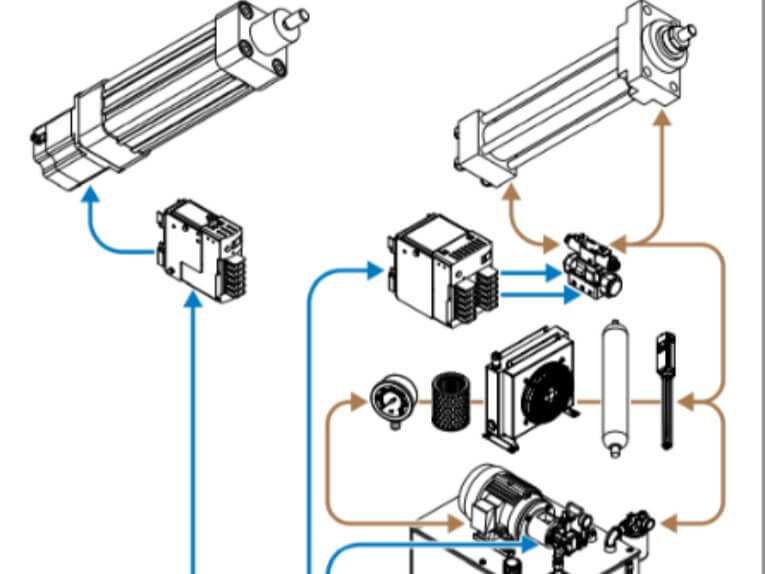
Hydraulic cylinders, known for high force at an affordable cost, have been widely used in factory automation equipment and other special automation equipment for decades. Hydraulics are rugged, relatively simple to deploy and provide a low cost per unit of force. In recent years, electric rod actuators (servo cylinders) have become more flexible, precise and reliable with increasingly larger force capacities. These advancements have created an ongoing debate over which technology—hydraulic cylinder or electric actuator—offers the best overall solution.
1. Electric Rod Actuators vs. Hydraulic Cylinders: System Components
The number of components and overall space required for a hydraulic cylinder system is much greater than an electric system. Hydraulic systems require:
-
A cylinder
-
A power unit to provide oil pressure
-
Control and accessory valves
-
Filters
-
Hoses
-
Fittings
-
Additional components
Hydraulic cylinders offer a compact footprint at the work point (where the power density is required), but the hydraulic power unit (HPU) which regulates flow and pressure to these actuators and other components, can require a large footprint in floor space. HPUs are not small and typically are placed near the actual cylinder itself, further increasing the system footprint. In very large systems with remote mounted HPUs, long lengths of hose can decrease the overall rigidity and efficiency of the hydraulic system.
Electric rod actuators provide a smaller overall footprint. These systems utilize a mechanical actuator; a motor (servo, or other); an optional gearbox; cables; and a drive/amplifier, which is usually mounted in a control cabinet.
Although the electric actuator—due to its design of integrating a power screw and bearing system—does require additional length over a hydraulic cylinder, when considering the overall system footprint, this additional length is more than compensated for by the much smaller footprint of the servo drive—the functional equivalent of the HPU. Typically, automation equipment utilizes a control cabinet and can be designed for an additional drive. Size requirements for a servo drive are normally a fraction of the size requirements of a HPU.
In new system designs, if the additional space at the work point can be made to accommodate the electric actuator’s working stroke and overall length, the overall footprint of the machine can be greatly decreased by eliminating the need for large power units.
2. Electric Rod Actuators vs. Hydraulic Cylinders: Motion Control Capabilities
The main reason engineers select an electric actuator system over a hydraulic cylinder system is the flexibility of its motion control capabilities: position control (multiple positions, accuracy); velocity control; control of acceleration/deceleration; control of output force; and complex control of all these motion variables on the fly. Electric actuators, coupled with a servo drive and motor system, have infinite control over position. Accuracy and repeatability of position are far beyond the capabilities of a hydraulic system.
Standard hydraulics are great for end-to-end position applications, but mid-stroke positioning is more complicated, requiring a control valve and operator assistance. Mid-stroke positioning is open loop and requires an operator to decide which position is acceptable. Additionally, speed control is monitored through a control valve and again requires an operator to dial in the acceptable speed for an application, but reaching an exact speed setting is often difficult to achieve. Once the speed setting is adjusted, the pressure force output required from a hydraulic cylinder is regulated through the pressure valve. Finally, the repeatability of position, speed and force of a hydraulic cylinder are subject to worn seals, leaks, pressure drops and spikes from the pump and other maintenance factors. It is difficult to get repeatable performance from day-to-day, month-to-month or year-to-year in a production environment when oil quality and viscosity change due to temperature variations. Obtaining the desired performance level will require constant operator intervention.
More advanced hydraulic systems, called “servo-hydraulic,” can precisely control position, velocity and force, but they require additional components—a servo controller, an electrohydraulic servo valve, and a position feedback device such as a linear transducer—which add significant complexity, space and cost. These components control the pressure and flow into the hydraulic cylinder, similar to how a servo drive controls current to a servo motor. Hydraulics also have even more advanced controllers, which allow multiple axes to be coordinated together. However, this is rare in hydraulics system implementation, and these controllers add extreme complexity and cost to the overall system. In addition, they can be quite sensitive and need regimented maintenance to ensure desired performance.
When combined with a servo control system, electric actuators offer more than infinite control and superior accuracy and repeatability. Multiple-axis servo controllers are readily available off-the-shelf on most modern control systems today. Controllers and electric actuators are more easily and cost effectively coordinated together in complex configurations over more limited hydraulic varieties. Velocity of one or multiple electric actuators is precisely and accurately controlled at all times and can easily blend from one speed to another without stopping or overrunning position. Acceleration and deceleration control means that electric actuators will not “bang” into hard-stops or jolt into action. This eliminates stress on frame elements and the need to over-engineer structures to withstand shock loads. All movements will be smooth—allowing electric actuators to be used in mission-critical processes where machine vibrations are not acceptable or process speed is affected. Force is controlled through current to the servo motor. Since servo controllers have precise control over current, almost all electric actuators provide accurate and repeatable control of force output at the work point.
Finally, an important feature of electric actuators is their ability to provide programmable control of all the motion profile variables. As a result, the only operator interaction required is the up-front design time to build desired performance variables into a PLC or another controller’s programming environment. Once set, the operation repeats from day-to-day, month- to-month and year-to-year. Furthermore, with the use of HMI (Human Machine Interface) screens, the variables of position, velocity, acceleration/deceleration and force can be easily changed at any time, providing maximum flexibility. In an OEM environment, system performance will be easier to control due to the increased consistency of an electric vs. a fluid system.
3. Electric Rod Actuators vs. Hydraulic Cylinders: Force Capabilities
Due to their high operating pressures, hydraulic cylinder systems are great at producing extremely high forces. Typical pressures range from 1800 to 3000 psi (124.1 to 206.8 bar). In some high-pressure hydraulic systems, pressure ratings up to 5000 psi (344.7 bar) are used to further emphasize power density. Since hydraulic cylinders operate on the Force = Pressure x Area fluid power principle, the high pressures allow smaller cylinders to reach very large forces. For example, 3-inch and 5-inch bore cylinders at 2200 psi could achieve approximately 15,000 lbf (66,723.3 kN) and 43,000 lbf (191,273.5 kN), respectively. However, hydraulic cylinders are not usually used to their full output force capability; they are typically oversized to improve control.
When considering electric actuators, it is important to determine the working force required. To estimate the approximate force required for an electric actuator, the typical approach is to adjust the hydraulic work port or system pressure until the operation can no longer be performed. Electric actuator systems rely on current through the servo motor to produce torque to the mechanical system, which drives the power screw to turn and generate force. This is a huge advantage; force is instantaneous. In hydraulic systems, where system rigidity is not optimized, the hydraulic actuator must wait for pressure to build until force is achieved. Another big advantage with electric systems is that the servo controller automatically regulates the current. The electric actuator system essentially uses current “on demand.” Any adjustment happens automatically. A hydraulic power unit must always keep pressure in the system for the hydraulic cylinder to actuate, which can be highly difficult.
When selecting an electric actuator system, it is important to consider the motor’s RPM and torque capabilities, coupled with the screw lead in the electric actuator. Matching speed and torque from the servo motor with the lead screw’s mechanical output can be complex. Achieving the extreme forces that hydraulics can produce is entirely possible with electric technology, but typically, the electric actuator deployed will have a larger body diameter and the electric actuator system will have a velocity maximum that can’t be exceeded. The complexity in sizing a system can easily be overcome as actuator and servo component manufacturers provide easy-to-use motion control sizing software packages that factor in all these variables.
4. Electric Rod Actuators vs. Hydraulic Cylinders: Velocity Capabilities
Achieving high velocities at high forces presents challenges for both hydraulic and electric technologies. Hydraulics require pressure for force and flow for speed. To achieve higher speeds at higher forces, there must be enough pressurized oil in the system to basically push the required volume of oil into a cylinder in the required amount of time (defined as flow). This typically requires an accumulation system to hold the pressurized volume. The problem can multiply with long stroke cylinders; uncharged accumulators may starve the system of oil. In the end, deploying additional capacity in hydraulic accumulator systems allows them to achieve high speeds at high forces. The downside of this practice is that without servo-hydraulic control on the hydraulic system, excess energy (force x velocity) is essentially being utilized in an open loop control scheme.
As stated earlier, the force capabilities of an electric actuator system depend on the right combination of servo motor RPM, servo motor torque and mechanical advantage from screw lead and possibly a gearbox. As servo motors increase in size, torque typically increases significantly but RPMs decrease. In extreme applications of force and speed, the only way an electric actuator system may be able to achieve the desired performance is to grossly oversize the system—which can be cost prohibitive. Alternately, remember that an electric actuator system has complete control over the motion profile; it doesn’t have to stroke the entire length of each cycle. Plus, with control of acceleration and deceleration, the electric system can settle more quickly, which reduces cycle time and increases efficiency. Finally, electric actuator technology may alleviate some of the peak velocities required as more intelligent, shorter moves can be executed.
Post time: Jul-20-2026