





Hydraulic actuators have an industry reputation for delivering high force. Hydraulic systems are usually less expensive from a purchased cost standpoint to implement than an electric servo system. Their drawbacks include a larger space footprint, regular maintenance and manual system adjustments for optimal system performance. Hydraulic systems are susceptible to fluctuations in temperature, prone to leaks and operate in an open loop environment, posing challenges for data collection. Although servo-hydraulics can be implemented to alleviate some of these issues, they result in a larger space footprint and are very costly to employ. Hydraulics do offer a long service life, but they are not as efficient operators as electric systems.
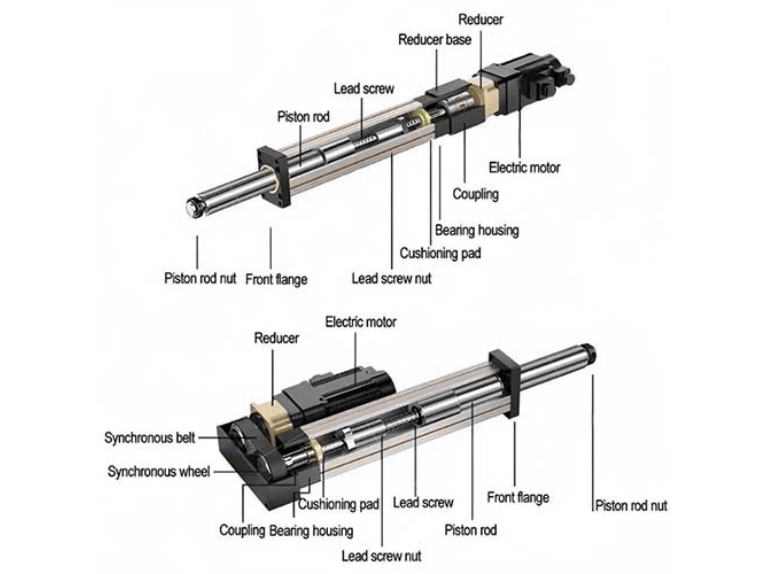
Electric systems offer smaller overall space requirements than hydraulic systems. They also provide precise position, velocity and speed control with more efficient operation. They operate in a closed loop environment for easy data collection, and they are virtually maintenance free. Preferred for their higher level of accurate performance, electric servo systems can be more costly than hydraulic to initially implement. However, the increased efficiency of operation with little or no maintenance over the life of the system makes their total cost of ownership lower over the life of the equipment and an attractive alternative to hydraulics.
1. Data Collection
In the never-ending quest to improve manufacturing processes, data collection in critical areas is becoming more and more prevalent in today’s manufacturing environment. Hydraulic cylinders require expensive, complex servo-hydraulic systems with additional sensors to track and monitor position, velocity, force and other factors happening at the work point. These factors are all built into an electric actuator’s servo system. Monitoring the motor current makes it easy to track force and repeatability. The feedback device on the motor registers accurate position and velocity.
2. Efficiency and Cost
Electric actuator systems typically operate in the 75-80% efficiency range for the work they complete; hydraulic actuator systems typically operate in the 40-55% efficiency range. An additional factor in the electric utility cost equation is that electric actuators only demand current to the motor when it is required. When electric actuators are at rest, they require no current or very low amounts of current to hold their positions. Hydraulics require that the power unit keep the hydraulic system pressurized at all times when the system is turned on—resulting in inefficient use of power.
By dividing the efficiencies of the two technologies into one another, an approximate factor can be determined on electric utility cost based on when the actuators/cylinders are actually moving.
For example: 80% (electric) / 40% (hydraulic) = 2. This results in electric being twice as efficient or hydraulic taking twice as much power to do the same work. This is an approximation, but it is not far from reality. In fact, unless a hydraulic system is properly maintained, the overall efficiency of the system can drop to 20%, making electric technology up to 4 times as efficient (or hydraulic utility costs up to 4 times higher).
Although electric actuator systems are twice as efficient as hydraulic cylinder systems, an electric servo solution can be more expensive to implement initially. But the cost over the life of the system can be substantially less when considering the increased performance, system flexibility and decrease in utility costs.
3. Leaks and Environmental Concerns
Many hydraulic industry professionals have said, “It is not a matter of IF hydraulics will leak, but a matter of when and by how much.” Leaks create messes in the manufacturing environment and also present a safety hazard if someone slips on the spill. More alarming is leaks could cause serious contamination to key processes and products—such as food processing, pharmaceuticals, medical devices and others. A contamination event can be costly both in terms of clean-up and scrapped product—and even more costly if the contaminated product reaches consumers and is then recalled. Additionally, many hydraulic systems are deployed outdoors and in the vicinity of living spaces and fresh water. Leaking oil into the surrounding environment can be a major concern for communities.
Electric actuator technology is one of the cleanest linear motion technologies that can be actively and easily deployed. Grease on the lead screw is the only potential contaminant; special greases (food grade, clean room, etc.) can be applied if required. The high-quality seals used on the rod of the electric actuator keep grease inside the actuator, virtually eliminating contamination issues.
Post time: Aug-04-2026