





1. What is an Electric Cylinder?
An Electric Cylinder is an electromechanical device used to produce linear motion (a straight-line forward or backward movement). Essentially, it’s a type of actuator or drive that operates electrically to move objects or parts in a straight line.
The basic operation of an Electric Cylinder involves converting rotational motion into linear motion. This is typically achieved using a Screw Drive mechanism or a rack-and-pinion mechanism. When the electric motor is activated, it turns the screw or the pinion, causing the cylinder rod to move forward or backward.
Electric Cylinders are often characterized by their aluminum profiles. These profiles allow for an easy attachment of mounting plates, limit switches, and reed sensors. The modular design of Electric Cylinders makes them versatile for various applications.
2. Sizes and options
The Electric Cylinder (Servo Cylinder) is available in three different sizes and can exert forces ranging from 2000 N to 20,000 N. They can be customized according to an existing modular system. To vary the stroke speed and stroke force, a planetary gearbox is used.
3. What versions are available?
Essentially, there are two main configurations: coaxial and parallel. This refers to the orientation of the motor. In the parallel configuration, the motor is mounted parallel to the spindle axis. The advantage of this is that it saves space along the axis. However, the redirection is more costly due to additional components needed for the redirection. If a particularly narrow solution is sought to fit into an existing hollow profile, the coaxial configuration offers a slimmer option to optimize space utilization.
4. When should an Electric Cylinder be chosen?
An Electric Cylinder offers the opportunity to configure a ready-made solution that includes all control options.
As a user, you no longer need to worry about external limit switches, position sensors, or external three-phase motors, as you receive a compact unit. The aluminum profile ensures that all sensitive components are protected (IP65 rating) and are lubricated for life—making it low-maintenance. Additionally, the Electric Cylinder covers a wide range of speeds (1 mm/s to 600 mm/s), providing a broad spectrum of solutions.
6. Applications of Electric Cylinders
Electric Cylinders are used in a variety of applications where precise and repeatable linear movements are required. Some examples of applications include:
Industrial Robotics – Electric Cylinders are used to control the movement of robotic grippers, tools, and other components.
Automatization - In manufacturing lines and automated systems, Electric Cylinders are used to position and move workpieces.
Medical Technology – Electric Cylinders are used in medical devices such as patient beds, operating tables, and diagnostic equipment.
Automotive Engineering - In some vehicles, Electric Cylinders are used to adjust seats or open and close roofs.
Farming – Electric Cylinders can be used in agricultural machinery to perform various functions, such as lifting mowers or adjusting planting equipment.
7. Advantages and Disadvantages
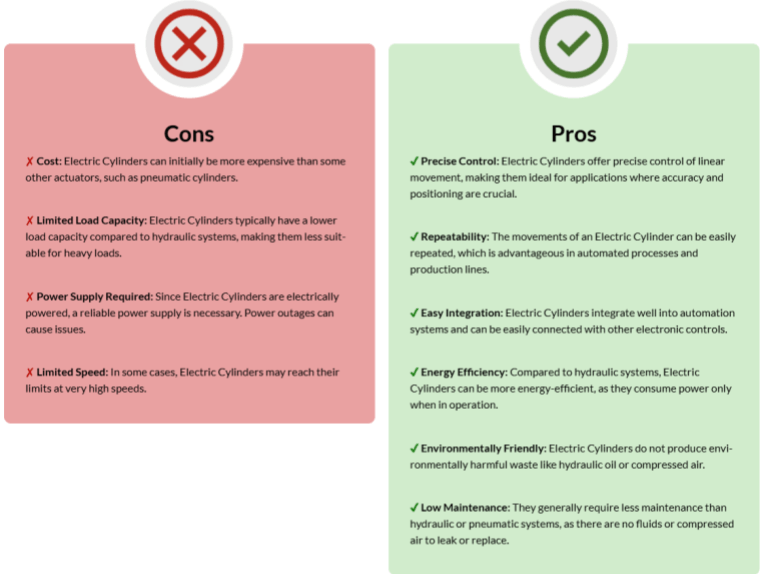
Cons:
Cost – Electric Cylinders can initially be more expensive than some other actuators, such as pneumatic cylinders.
Limited Load Capacity – Electric Cylinders typically have a lower load capacity compared to hydraulic systems, making them less suitable for heavy loads.
Power Supply Required – Since Electric Cylinders are electrically powered,a reliable power supply is necessary. Power outages can cause issues.
Limited Speed – In some cases, Electric Cylinders may reach their limits at very high speeds.
Pros:
Precise Control – Electric Cylinders offer precise control of linear movement, making them ideal for applications where accuracy and positioning are crucial.
Repeatability – The movements of an Electric Cylinder can be easily repeated, which is advantageous in automated processes and production lines.
Easy Integration – Electric Cylinders integrate well into automation systems and can be easily connected with other electronic controls.
Energy Efficiency – Compared to hydraulic systems, Electric Cylinders can be more energy-efficient, as they consume power only when in operation.
Environmentally Friendly – Electric Cylinders do not produce environmentally harmful waste like hydraulic oil or compressed air.
Low Maintenance – They generally require less maintenance than hydraulic or pneumatic systems,as there are no fluids or compressed air to leak or replace.
Post time: Apr-20-2026