





The world is full of mobile machines, whether it’s agricultural tractors, forestry equipment, or mining vehicles; actuators are the core for motion controls. They transform energy into mechanical movement that allows tasks such as lifting and pushing, steering and repositioning loads.
In the past, hydraulic actuators dominated mobile devices. However, with the rapid advancements in automation and electrification, electric actuators are rapidly gaining ground.
Which is the better choice for mobile machines: hydraulic or electric actuators?
The truth is that it is dependent on the software. This blog examines the two technologies in depth to assist you in making the best choice.
What are hydraulic actuators?
What Are Hydraulic Actuators? Hydraulic actuators utilize pressurized oil (usually oils) for the movement of a piston within the cylinder, resulting in circular or linear motion.
They are extensively used in:
- Excavators
- Loaders
- Cranes
- Forest harvesters
Their greatest strength is the raw power and strength.
What are electric actuators?
Electric actuators transform electrical energy into motion through gears, motors, and leadscrews.
They are often employed in:
- Automated systems
- Compact mobile machines
- Electrified construction equipment
Their greatest advantage is accuracy and efficacy.
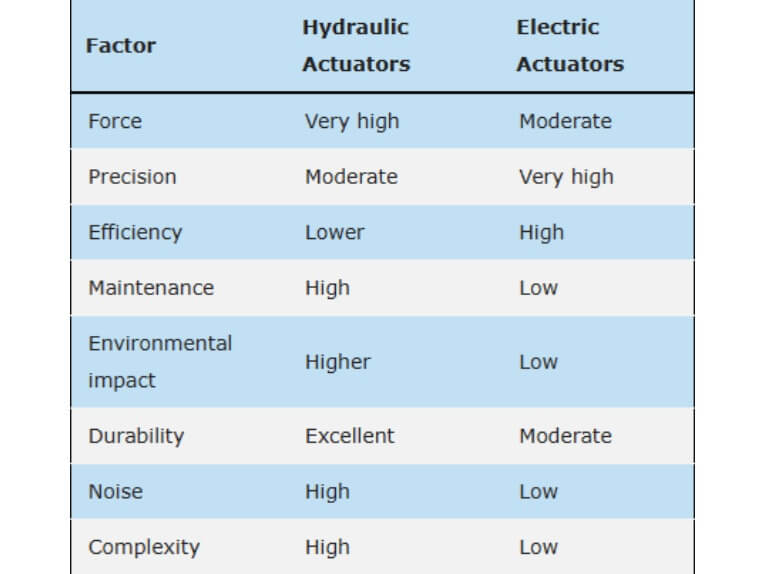
Key comparison factors
To determine which one is the best, we must examine them in relation to key aspects that are relevant to mobile machines.
1. Force and power density
This is where hydraulic systems have a dominant position.
Hydraulic actuators can produce very high forces, sometimes reaching many thousands of Newtons, from cylinders that are compact cylinders.
They are great for:
- Heavy lifting
- Excavating and digging
- High-load operations
Electric actuators, despite their improvements, aren’t able to match the force of this magnitude, especially on large machines.
Winner Hydraulic actuators
2. Precision and control
Electric actuators are highly precise.
They provide:
- Accurate positioning
- Programmable motion control
- Integration with sensors and automated systems.
Modern electrical systems can attain high-precision positioning with encoders and other feedback devices.
Hydraulic systems can be extremely precise as well, but they require:
- Valve servos
- Complex control systems for complex control
- Higher maintenance
Winner electronic actuators
3. Energy efficiency
Electric actuators are considerably more energy efficient.
Hydraulic systems generally operate at 45 to 60% efficiency due to friction in the fluid, leakage, and pump losses.
Contrast:
- Electric actuators use energy only when they are operating.
- They can reduce the loss of energy
A few studies suggest that electrical systems could almost double the efficiency in some machines.
Winners electric actuators
4. Maintenance and reliability
Hydraulic systems need:
- Regular oil adjustments
- Monitoring for leaks
- Replacement of seals and hoses
Leaks can be a significant issue that can cause downtime as well as environmental hazards.
Electric actuators:
- Is there the smallest number of components
- Require minimal maintenance
- Eliminate the handling of fluids
Winner electronic actuators
5. Environmental impact
Hydraulic systems pose environmental concerns due to:
- Leaks of oil
- Fluid disposal
- Contamination risks
Electric actuators can eliminate these issues completely, which makes them greener.
Winner electronic actuators
6. Durability and shock resistance
Mobile equipment is often used in harsh environments.
- Dust
- Vibration
- Shock loads
Hydraulic actuators are extremely robust and are able to absorb shock loads with ease because of fluid damping.
Electro-actors have sensitivity:
- Impact
- Overloads
- Conditions of the environment
Winner hydraulic actuators
7. System complexity
Hydraulic systems need:
- Pumps
- Reservoirs
- Valves
- Hoses
- Filters
They are:
- Heavy
- Complex
- Space-consuming
Electric actuators are smaller and self-contained.
Winner electric actuators
8. Noise levels
The noise of hydraulic systems is due to:
- Pumps
- Fluid flow
- Pressure systems
Electric actuators work quietly, making it easier for operators to relax and reduce the noise level.
Winner electric actuators
9. Cost considerations
Hydraulic actuators
- Lower initial cost (in some instances)
- Costs of maintenance and operation that are higher
Electronic actuators
- Greater initial investment
- The costs of life are lower due to efficiency and decreased maintenance
The winner is determined by the perspective of the lifecycle
Real-world applications in mobile machinery
Where hydraulic actuators are still best
Hydraulics continue to be the option for:
- Excavators
- Wheel loaders
- Bulldozers
- Cranes
- Mining equipment
These applications need:
- Extreme force
- Continuous heavy-duty operation
- High shock resistance
Hydraulic systems are the industry norm for large-scale machines.
Where electric actuators are gaining ground
Electric actuators are becoming more popular in the following areas:
- Compact construction equipment
- Autonomous machines
- Vehicles that are electrified
- Agricultural automation systems
The benefits of these are:
- Integration with control systems is easy and seamless.
- Energy savings
- Maintenance reduced
The rise of electrification in mobile equipment
The industry of mobile machinery is going through a major change that is triggered by:
- Electrification
- Automation
- Sustainable goals
Electric actuators play a major component of this change.
They allow:
- Fully electric machines
- Smart control systems
- Emissions reduced
However, they are not yet a complete replacement for hydraulics–especially in heavy-duty applications.
Hybrid systems: the best of both worlds?
Instead of picking one over the others, a lot of companies are opting for the hybrid approach, which combines:
- Hydraulic actuators designed for lifting heavy loads
- Electric actuators for precise control
This method provides:
- Power + precision
- Efficiency + durability
It’s becoming a trending strategy in the field of advanced mobile machinery design.
Final verdict: which is better?
There is no universal solution.
Select hydraulic actuators when:
- You’ll need the most force and strength
- Your machine is operating in extreme environments.
- You need constant, high-performance performance
Select electric actuators if
- You require precise and controlled
- Efficiency in energy is a top priority
- You’re looking for lower maintenance and a more efficient operation.
Hydraulic actuators have been powering mobile machines for a long time and won’t be going anywhere anytime soon. Their incredible force and durability make them ideal for demanding applications.
But the electric actuators are rapidly changing. They offer advantages in precision, efficiency, and long-term sustainability. They are now the most popular option for modern, electrified equipment.
Mobile machines are likely not a fight between hydraulic and electric systems, but the clever combination of both.
Post time: Aug-17-2026