





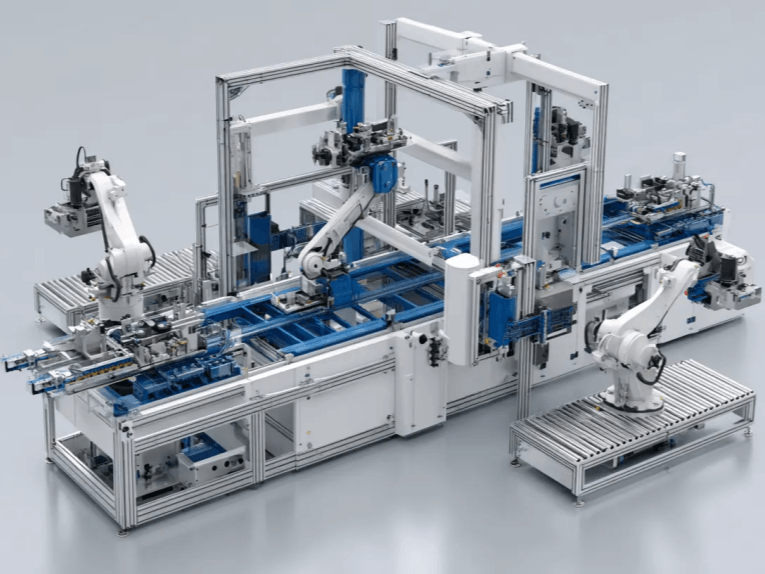
Gantry systems have various applications in semiconductor manufacturing, automotive production, medical/laboratory automation, and general manufacturing, highlighting the role gantries play and the benefits they provide in each sector.
Semiconductor Industry: Micron-Precision Wafer Handling
The semiconductor industry arguably pushes gantry systems to their precision limits. In semiconductor fabrication and assembly, extremely fine positioning is required.
Gantry stages are used in wafer steppers and lithography machines, where silicon wafers must be moved under optics with nanometer-level accuracy. These gantry stages (often X-Y stages) use air bearings and linear motors to achieve ultra-smooth motion, and interferometer feedback to correct position down to fractions of a micron. Even a slight misalignment during photolithography can ruin an entire microchip, so these are among the most precise gantries in the world.
Another use is in pick-and-place of semiconductor chips or packaging. For example, placing tiny silicon dies onto packages or circuit boards requires both precision and gentle handling. Gantry robots equipped with vision systems pick microscopic chips and place them with ±5 µm accuracy or better. The earlier mentioned example of high-resolution encoders achieving ±1 µm accuracy is applicable here – such precision gantries ensure that each chip lands exactly where it should on a wafer or substrate.
Automotive Industry: Heavy Lifting and Large-Scale Automation
Automotive manufacturing leverages gantry systems for handling heavy components and spanning large areas in assembly lines.
Overhead gantry robots transfer items like engines and windshields, requiring robust designs with powerful servo drives and dual-support rails to manage substantial weights. Material handling gantries, akin to small rooms, move parts racks and load machine tools, offering superior workspace and load capacity compared to articulated robots. Examples include welding car panels and automated warehouse retrieval, emphasizing strength and reliability over micron-level precision.
A significant trend involves integrating gantry and articulated robots, where a six-axis robot is mounted on a gantry for tasks like car painting. This hybrid approach combines the gantry’s reach and payload capacity with the articulated robot’s dexterity, enabling nuanced motion for complex tasks. Automotive gantries prioritize reliability in harsh environments, incorporating features like automatic lubrication and robust sensors, while also sometimes operating collaboratively alongside human workers.
Medical and Laboratory Automation: Precision and Reliability in Handling
The medical field, including laboratory automation, has seen increasing use of gantry systems for tasks that demand both precision and sterility.
Laboratory automation gantries are essentially small Cartesian robots that handle samples – for example, moving test tubes, pipetting liquids, or sorting lab trays. These gantries might be inside a clinical analyzer machine, carefully dispensing reagents into dozens of samples around the clock.
Important considerations in medical gantries are cleanliness, reliability, and gentle handling. They often use food/medical grade components (stainless steel, special plastics) and are designed to be cleaned easily. In pharmaceutical production, gantry robots might fill vials or move plates in a cleanroom environment, so they must emit low particles and withstand cleaning agents. Also, because human samples or delicate biological materials are involved, the motion must avoid shaking or spilling. Smooth acceleration profiles and fine control are implemented to prevent abrupt motions.
Another area is medical imaging and treatment devices. The term “gantry” is even used in CT scanners and radiation therapy machines, albeit those are rotational gantries (a large ring that rotates around the patient). While not a linear gantry, it shows the broad sense of the word in medicine: a structure that moves equipment (an X-ray source) around a subject. In proton therapy or modern radiotherapy, huge gantries weighing several tons rotate to direct beams at tumors from precise angles – an engineering marvel in its own right, requiring superb rigidity and control to aim beams accurately.
General Manufacturing and Assembly: Flexibility and Efficiency
Beyond the specialized sectors above, gantry systems are ubiquitous in general manufacturing. Any process that requires moving something from point A to B in a planar workspace could potentially use a gantry robot. A few examples include:
1. Pick and Place & Packaging: Packaging factories use gantry robots to place products into containers, sort items, or palletize boxes. For instance, a candy factory might use a high-speed gantry to sort chocolates into assortments. These systems emphasize speed and gentle handling. They might use vacuum grippers on a gantry to pick multiple items at once and drop them into a box in a specific arrangement. Because of the repetitive nature, a gantry’s reliability and speed directly translate to throughput (e.g., X products per minute).
2. Palletizing: Stacking heavy goods onto pallets can be done by a gantry that moves over a pallet area, placing items in a grid. Automotive and food/beverage industries employ gantry palletizers for cases of products or parts. Gantries are well-suited here because they can span the entire pallet and stack high, something that would require a very large articulated arm otherwise.
3. Machine Tending: A gantry robot can service multiple CNC machines, loading raw parts and unloading finished parts. The gantry runs above a row of machines, reaching in to pick parts from chucks or fixtures. This maximizes machine utilization and minimizes human intervention in potentially dangerous areas.
4. Fabrication & Cutting: Plasma cutting tables or laser cutters sometimes use gantry systems to move the cutting head precisely over large sheets of metal. Similarly, large-format 2D printers (billboards, textiles) use gantry motion for the print heads. These require precise tracking over sometimes several-meter spans, which gantries handle well.
5. Agriculture Automation: Even in agriculture, gantry systems appear, such as automated gantry systems that move above crops for tasks like pruning, spraying, or harvesting in controlled environment farms. They cover large growing beds by moving on rails much like a Cartesian gantry, ensuring each plant gets attention.
6. Warehouse Automation: While many warehouses use mobile robots or conveyors, some use gantry-like systems for sorting. For instance, an overhead X-Y gantry with a gripper might pick items from bins and place them into orders. Warehouse automation systems benefit from vision integration and AI to decide pick targets, with the gantry providing the physical motion platform.
Post time: Nov-11-2026