





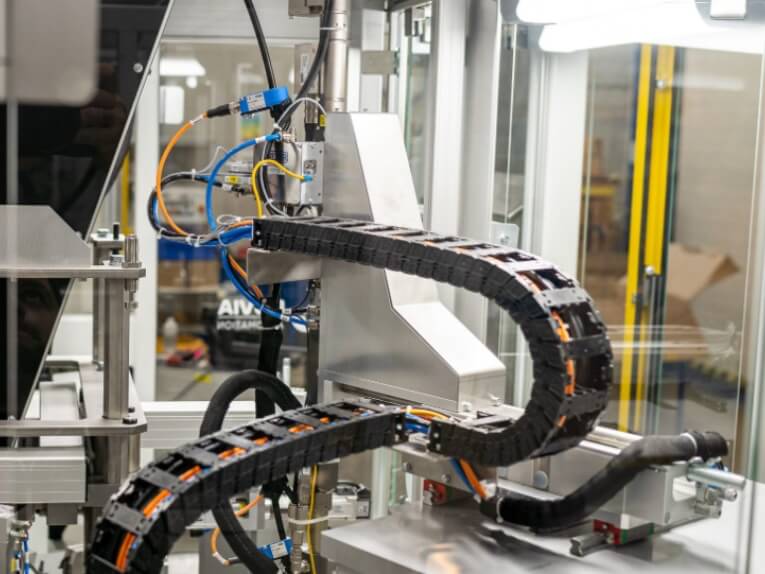
Gantry systems stand as a cornerstone of automation, offering a unique blend of precision, speed, and load capacity. From fundamental components to diverse configurations like Cartesian, polar, and cylindrical, they adapt to various industrial demands. Key strengths include large work envelopes without sacrificing accuracy and a balanced design considering load, speed, precision, and environment. Looking ahead, Industry 4.0 integration with sensors and AI will enhance gantry capabilities, enabling self-optimization and coordination with other robots. Pre-engineered modules and advanced technologies like composite materials and direct-drive systems will further improve performance and ease of deployment.
FAQ
1. What is a gantry system in simple terms?
A gantry system is a mechanical platform that moves a tool or payload in multiple linear directions (typically X, Y, and Z). It usually consists of an overhead frame with rails and a moving carriage (or robot) that can position itself anywhere within a defined area. In essence, it’s like a bridge crane or plotter that can precisely carry something to specific coordinates. Gantry systems are often called Cartesian robots because they operate on the Cartesian coordinate system. They are known for high precision and the ability to handle large or heavy items over a big workspace.
2. What components make up a gantry system?
A gantry system is composed of a few key components:
- Frame and Linear Rails: The rigid structure and tracks that define the paths of motion . The rails guide the moving parts in straight lines.
- Bearings/Slides: These are the interfaces between moving carriages and rails, allowing smooth, low-friction movement (e.g., ball bearing slides or linear guides) .
- Motors and Drive Mechanisms: Motors (stepper or servo) provide motion, usually through drive systems like ball screws, belts, or rack-and-pinion to convert rotation to linear travel. They control how fast and accurately the axes move.
- Control System: This includes controllers (PLC or motion controller), drivers for the motors, and software/firmware. The control system coordinates multi-axis movement and takes care of precision, using feedback from encoders or sensors.
- End Effector (Tool): Although not part of the gantry itself, the tool attached (gripper, welder, dispenser, etc.) is what the gantry moves around to perform work. The design may include tool changers or mounts for these.
3. In which industries are gantry systems commonly used?
Gantry systems are used in many industries wherever precise and automated motion is needed across a large area. Some examples:
- Manufacturing & Assembly: Automated assembly lines, material handling, packaging, and palletizing tasks . Gantries pick and place parts, or load and unload machines.
- Automotive: Handling heavy components like engines or car bodies, welding or painting car parts, and storage systems for parts .
- Semiconductor & Electronics: Wafer handling, chip placement, PCB assembly, and CNC machining of components – requiring very high precision (micron-level) .
- Medical & Pharmaceutical: Laboratory automation (sample handling gantries, pipetting robots), automated drug dispensing, and even imaging devices (CT or radiation therapy gantries).
- Logistics/Warehousing: Some warehouses use gantry robots for sorting or retrieving items (like an overhead crane that can move boxes in X-Y).
- 3D Printing and CNC: Most large 3D printers or CNC routers are essentially gantry systems guiding a toolhead to create or cut objects.
Across these industries, gantries provide speed, accuracy, and repeatability, making processes more efficient and often running 24/7 with minimal human intervention .
4. How precise and fast can gantry systems get?
Gantry systems can be extremely precise and also quite fast – though the exact performance varies by design:
- Precision: High-end precision gantries (like those in semiconductor manufacturing or precision machining) can achieve positioning accuracy on the order of a few micrometers or even sub-micron. For example, with high-resolution encoders and feedback control, a gantry can position to about ±1 µm . Repeatability (hitting the same spot consistently) can be even finer, a few micrometers or less, if the system is properly calibrated and stable. On more standard industrial gantries (for assembly or packaging), typical repeatability might be ±0.02–0.1 mm, which is sufficient for those tasks.
- Speed: Gantry robots can also move very fast. Some lightweight gantries reach speeds of 1–3 meters per second on linear axes . In practice, many operate in the range of a few hundred mm/s to 1000+ mm/s depending on the task. For instance, a pick-and-place gantry in electronics might move at 1.5 m/s to quickly position parts. There are trade-offs – at extreme speeds, one might sacrifice some precision due to vibrations and need longer to settle at the target position.
- Acceleration: Equally important is acceleration, as it determines how quickly the gantry can get up to speed or make small moves. Some precision stages accelerate at 1–2 G (9.8–19.6 m/s²) for tiny moves. Larger gantries may accelerate slower (to avoid shaking heavy loads).
In summary, top-tier gantry systems combine fine accuracy with high speed, but achieving both requires advanced engineering. The majority of industrial gantries are tuned to balance speed and accuracy for the intended application (e.g., a packaging gantry might prioritize speed ~1 m/s with 0.5 mm accuracy, whereas a machining gantry might go slower but hold 0.01 mm accuracy).
5. Can gantry systems be customized for specific applications?
Yes, gantry systems are highly customizable. In fact, many gantry solutions are built or configured specifically for the application’s needs . Customization can involve:
- Size and Axes: Adjusting the length of travel on each axis, adding a third or fourth axis (like a second Y or a rotation axis) if needed, or even building very large-scale gantries for big projects (e.g., construction panels or aircraft assembly).
- Load and Motor Sizing: Selecting more powerful motors, different drive mechanisms (belt vs screw), or adding gear reduction to handle heavier loads or achieve higher precision.
- Precision Level: Upgrading to higher precision components – for example, using linear encoder feedback or premium low-backlash gearboxes for applications that need tighter accuracy.
- Materials and Structure: Using specialized materials (like stainless steel for cleanrooms or carbon fiber for lightweight arms) and tailoring the frame design to the space or mounting requirements.
- Software/Control Features: Customizing the control algorithms, adding specific sensors (such as vision systems or force sensors), and programming the software for the task (like integrating certain motion profiles or communication protocols to talk with other machines).
- End Effectors and Tooling: Designing the gantry’s end-of-arm tooling to do exactly what’s needed – be it a vacuum gripper that picks oddly shaped objects or a tool changer that swaps between a drill and a camera.
Understanding gantry systems is crucial for engineers, as they exemplify mechatronic design principles. Their prevalence in industrial automation and potential for future advancements, including integration with machine vision and articulated robots, underscores their significance. As automation expands into e-commerce and pharmaceuticals, gantries will play a vital role in handling tasks with precision and reliability. Mastering gantry design and programming empowers engineers to create efficient, reliable, and precise solutions, ensuring these systems continue to drive innovation in automation.
Post time: Nov-16-2026