





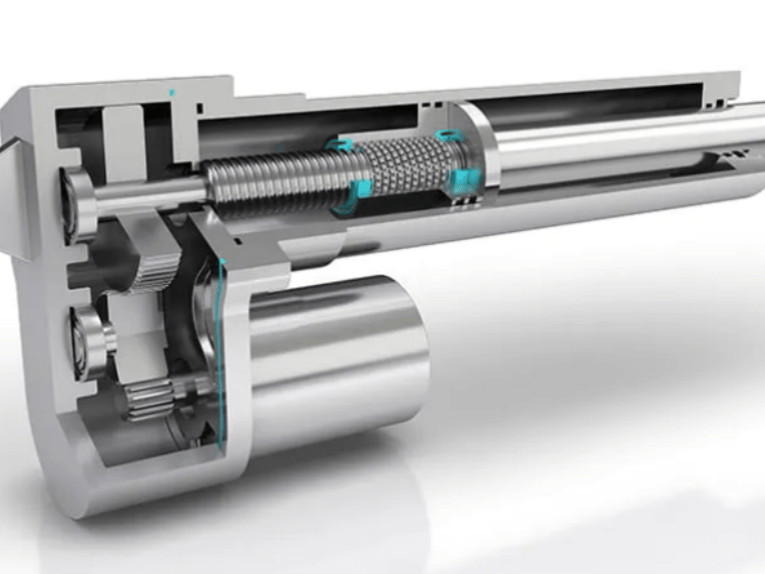
In the world of machinery and automation, actuators play a pivotal role as the “muscles” of various systems, silently powering the movement that brings machines to life. An actuator is essentially a device that takes an energy source — be it electrical, pneumatic, or hydraulic — and converts it into physical motion. This motion can be linear or rotary, and it can be used to control a system or mechanism. Actuators are the key components that enable precise control in both complex and simle equipment, from the delicate positioning of optical lenses to a home Automation system to lift a TV out of a cabinet. Linear actuators are devices that create motion in a straight line as opposed to the rotary motion of a conventional motor. They come in various modes of operation:
1. Electric Linear Actuators:
These are powered by electric motors that drive a mechanism, such as a lead screw or a belt drive, to convert the motor’s rotary motion into linear motion.
Example Application: They are widely used in industrial machinery for precision control of positioning, such as in CNC machines, or in consumer products like adjustable desks.
2. Pneumatic Linear Actuators:
These actuators use compressed air to drive a piston within a cylinder, producing linear motion. The force produced by these can be quite high, and speeds can be fast, however because air is compressible it can be very hard to have any level os precision, with pneumatic Actuators. For this reason, they tend to be used just for point-to-point applications.
Example Application: Pneumatic linear actuators are commonly used for applications requiring a low to medium force over a relatively short distance, such as in material handling or clamping operations.
3. Hydraulic Linear Actuators:
Hydraulic actuators also use a piston mechanism, but they are powered by pressurized hydraulic fluid. Because hydraulic fluid is a non-compressible material, it means Hydrailics are used for very high force applications. They do tend to be slow but make up for it in force. These types of systems are also builky and expensive because they require the system to use a high pressure hydraulic fluid pump to build the pressure, and a resevoir tank to hold the fluid.
Example Application: These actuators are suitable for very high force applications, such as in construction equipment like excavators and in industrial presses.
4. Mechanical Linear Actuators:
Mechanical linear actuators convert rotary motion into linear motion mechanically, often using screws or gears and are usually manually driven, so they would typically have a handle to wind and convert that rotary motion into linear motion.
Example Application: Mechanical actuators, like screw jacks, are used in lifting platforms and in automotive jacks.
5. Piezoelectric Actuators:
These actuators employ the piezoelectric effect to convert electrical energy into precise linear motion on a minute scale. Applying a voltage accross a Piezo stack as they are called in the industry makes the material expand and contract on a micro scale but with high force and high precision.
Example Application: Due to their high precision, piezoelectric actuators are used in most fuel injectors in vehicles. The Piezo stack will be used to open and close the fuel line in the injectors to devliver the right amount of fuel to each cylinder depenind on the throttle position. {iexo actuator are extremely fast to operate, making them ideal for applications like this.
Each type of linear actuator comes with its own set of capabilities, control methodologies, and suitable applications, often determined by the force required, the precision of movement, the speed of operation, and environmental considerations like temperature, cleanliness, and space constraints.
Post time: Apr-27-2026