





Introduction to Gantry Systems
A gantry system is a versatile, linear motion framework designed to position tools, sensors, or payloads with pinpoint accuracy over a specific work area. Often referred to as Cartesian robots, these automated systems operate along fixed linear paths (axes) to execute repetitive, heavy, or high-precision tasks.
From massive automated storage and retrieval systems in warehousing to microscopic precision in 3D printing and laser cutting, gantry systems form the backbone of modern industrial automation. Because they scale effortlessly, they offer distinct advantages over traditional robotic arms, particularly when dealing with heavy loads over vast distances.
How Do Gantry Systems Work?
At their core, gantry systems operate on the Cartesian coordinate system (X, Y, and Z). By combining linear actuators, rails, and a control system, they move a carriage or end-effector to an exact coordinate in space.
Core Components of Linear Motion
The primary components driving this motion include:
-
Linear Guides and Rails: Provide the track for movement, ensuring structural rigidity and straight-line accuracy. V-guide technology is common for heavy-duty or harsh environments.
-
Actuators: The drive mechanisms—typically belt drives, ball screws, or linear motors—that physically move the carriage.
-
Motors and Controllers: Stepper or servo motors provide the power, while the overarching control system dictates the exact speed, acceleration, and positioning.
-
The Bridge: The crossbeam that spans the work area, capable of supporting heavy tools or secondary axes.
Types of Gantry Systems
Gantries are categorized by the number of axes they utilize. Selecting the right configuration depends entirely on the spatial requirements of your manufacturing process.
Single-Axis Gantries (Linear Actuators)
These operate solely on a single plane (usually the X-axis). They are ideal for simple point-to-point material handling, such as transferring a part from one conveyor belt to another.
XY Gantry Systems (2-Axis)
An XY gantry utilizes two axes to move an object within a flat, two-dimensional plane. The X-axis usually forms the base, while the Y-axis acts as the bridge moving across it.
-
Common Applications: Laser cutting, flatbed CNC routing, automated inspection stations, and fabric cutting.
XYZ Gantry Systems (3-Axis)
Adding a Z-axis allows for vertical movement, turning the setup into a true 3D Cartesian robot. The Z-axis is mounted to the Y-axis carriage, allowing tools to be lowered and raised.
-
Common Applications: Pick-and-place packaging, 3D printing, automated welding, and robotic palletizing.
Gantry Systems vs. Industrial 6-Axis Robots
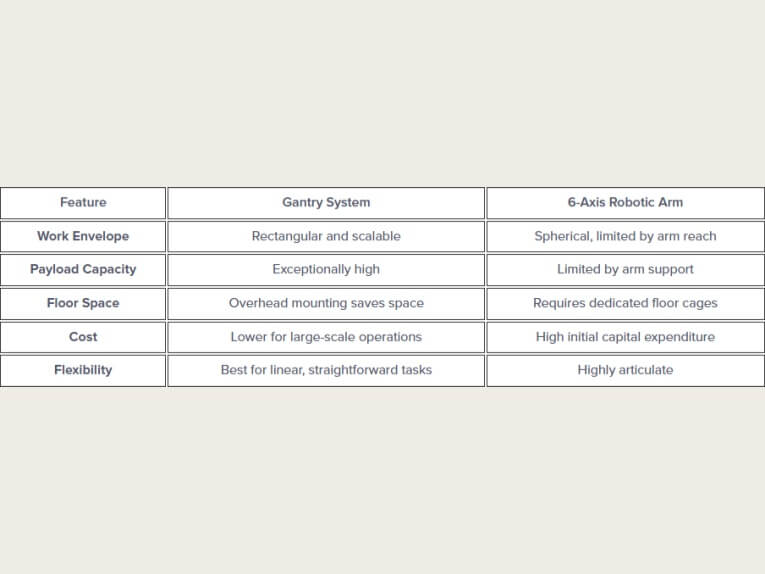
One of the most common questions engineers face is whether to deploy a gantry system or a traditional 6-axis robotic arm. While both automate tasks, they serve completely different operational needs.
For applications involving heavy, awkwardly shaped products moved over large distances—such as shifting steel beams or palletizing heavy crates—a gantry system is unequivocally the better, more cost-effective solution.
Key Applications and Industries
Because they are modular, gantry systems are highly adaptable. Their ability to handle heavy payloads without sacrificing precision makes them indispensable across multiple sectors:
-
Manufacturing & Assembly: Used to dispense adhesives, assemble automotive parts, and conduct automated screwdriving.
-
Logistics & Warehousing: Heavy-duty gantry systems power automated storage and retrieval systems (ASRS), moving large pallets efficiently.
-
Medical & Laboratory: Miniature, high-precision XY systems are used for liquid handling, DNA sampling, and medical imaging equipment.
-
Machine Tending: Moving raw materials into CNC machines and removing finished parts, operating continuously to reduce human error.
How to Specify and Choose a Gantry System
Selecting the wrong gantry configuration can lead to premature mechanical failure or sluggish production times. When configuring your system, you must evaluate four core metrics.
Payload Capacity and Load Calculations
You must calculate the static and dynamic loads. The system must comfortably support the maximum weight of your tools or materials. Overloading a system accelerates wear on the bearings and linear guides, severely impacting accuracy and longevity.
Stroke Length and Work Envelope
How far does the system need to travel? Belt-driven gantries are excellent for long strokes, whereas ball-screw drives are better for shorter, high-thrust applications.
Speed, Acceleration, and Drive Mechanisms
High-speed applications require different drive mechanisms (like linear motors) compared to slow, heavy-lifting tasks. Rapid acceleration also increases the dynamic forces on the gantry bridge, requiring a stiffer frame.
Operating Environment and Track Systems
If the gantry will operate in environments with high dust, debris, or chemical exposure, standard bearings will fail. You must specify enclosed actuators or debris-resistant V-guide track systems.
Maximizing System Life and Maintenance
To reduce downtime and lower your total cost of ownership (TCO), a proactive maintenance schedule is required.
-
Lubrication: Linear rails and ball screws require consistent lubrication to prevent metal-on-metal wear. Consider specifying automated lubricator blocks for continuous operation.
-
Alignment Checks: Misalignment across a wide bridge causes binding, which forces motors to draw more current and eventually fail.
-
Debris Management: Utilize wiper kits on carriages to sweep away abrasive dust before it enters the bearing blocks.
Frequently Asked Questions (FAQs)
What are XY and XYZ gantries?
XY and XYZ gantries are automated linear motion systems used for the precise positioning of tools, sensors, or payloads. They are named based on their axes of motion. An XY gantry operates on a two-dimensional flat plane (left/right and forward/backward), making it ideal for laser cutting or inspection. An XYZ gantry adds a vertical dimension (up/down), turning it into a 3D Cartesian robot ideal for pick-and-place packaging or 3D printing.
How does a gantry system compare to a robot?
While both are automated solutions, a gantry system operates on linear Cartesian coordinates, whereas a traditional industrial robot uses articulated joints. A gantry system can accomplish many of the same tasks as a robotic arm but typically incurs lower costs, scales more easily over vast distances, and can handle significantly heavier payloads. If your application involves moving heavy items over a large area, a gantry is usually the superior choice.
What should I consider when choosing a heavy-duty gantry system?
When specifying a gantry, your primary considerations should be payload capacity (including the weight of the tooling), stroke length (how far it needs to move), speed and acceleration profiles, and the operating environment. Failing to account for environmental debris or dynamic inertial forces can lead to premature mechanical failure.
What drive mechanism is best for a gantry system?
The best drive mechanism depends entirely on the application. Belt drives are ideal for high speeds and long stroke lengths. Ball screws offer excellent precision and thrust for shorter distances but are prone to “whipping” at long lengths. Linear motors provide the highest speed and precision but come at a premium cost.
Post time: Nov-23-2026