





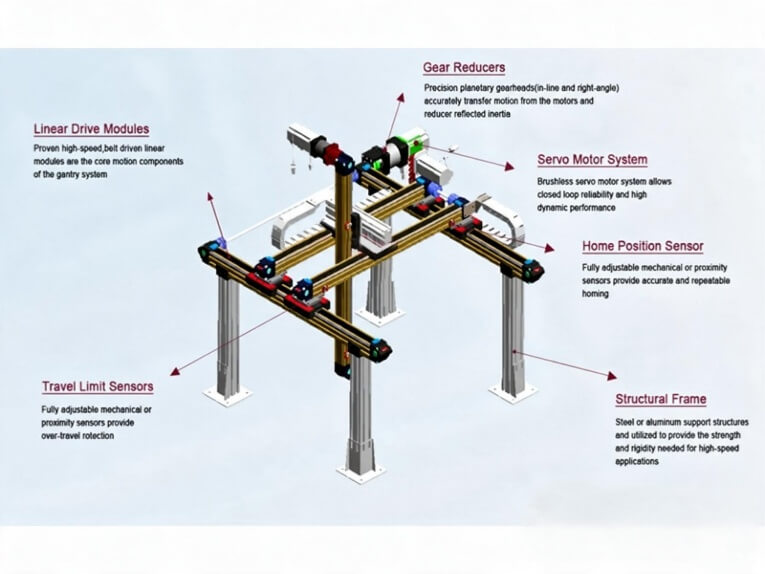
The primary types of gantry systems are often classified by the coordinate system they utilize or their geometric arrangement. Here we discuss the three main types – Cartesian, Polar, and Cylindrical gantry systems – along with their characteristics and typical use-cases.
Cartesian Gantry Systems
Cartesian gantry systems excel in applications demanding high precision and repeatability across extensive work areas. Their inherent design, featuring rigid, orthogonally aligned axes, ensures consistent accuracy throughout the entire range of motion. This stiffness, combined with straightforward mechanical components, simplifies maintenance and troubleshooting.
Consequently, Cartesian gantries are the preferred solution for tasks requiring precise linear movements, such as automated assembly, large-format printing, and CNC machining, where maintaining accuracy over a large rectangular or cubic volume is paramount. The modularity of these systems further enhances their appeal, allowing for customization and scalability to meet varying application demands.
Despite their strengths, Cartesian gantries exhibit limitations in certain scenarios. Their rectangular workspace can lead to inefficient utilization of space in non-rectangular layouts, and their linear motion restricts their ability to navigate around obstacles or follow complex, non-linear trajectories.
For applications requiring articulated movement or access to confined spaces, alternative gantry configurations, such as polar or delta systems, may offer superior performance. The larger physical footprint of Cartesian gantries can also be a disadvantage in space-constrained environments. Thus, while highly effective for linear precision tasks, the selection of a gantry system must consider the specific requirements of the application, including workspace geometry and movement complexity.
Advantages of Cartesian Gantries:
1. High precision across a large rectangular or cubic workspace.
2. Consistent accuracy due to stiff, guided linear motion.
3. Simplified maintenance and understanding due to straightforward mechanical design.
4. Ideal for applications requiring precise linear movement and high repeatability.
5. Modular design allows for scalability.
Limitations of Cartesian Gantries:
1. Less efficient for non-linear paths or navigating around obstacles.
2. Larger footprint, potentially leading to inefficient space utilization (e.g., unused corner space).
Polar Gantry Systems
Polar gantry systems, utilizing a polar coordinate system, employ a rotational base and radial arm to cover a circular or fan-shaped workspace, complemented by a vertical Z-axis. This configuration allows for efficient area coverage, particularly in space-constrained environments where a sweeping motion is required.
By rotating the arm around a central point, a polar gantry can access points within its circular range without the need for extensive linear movements, making it ideal for applications with radial layouts, such as circular assembly lines or round workpieces. This design advantage allows for a smaller footprint relative to the covered area, maximizing space utilization and enabling rapid angular repositioning.
The ability to reach points through rotational motion often results in faster repositioning compared to linear Cartesian systems, especially for angular displacements. Polar gantries excel in scenarios where access to points around a central location is crucial, offering a compact and efficient solution. Their design minimizes the need for large linear movements, streamlining operations and improving throughput in applications where a circular workspace is advantageous.
Polar Gantry Advantages:
1. Space-efficient (circular/fan workspace).
2. Fast rotational movement.
3. Good access around a center point.
4. Simplified movement for radial tasks.
Polar Gantry Limitations:
1. Poor for rectangular tasks.
2. Complex control for non-radial paths.
3. Singularity issues at center.
4. Limited arm reach.
Cylindrical Gantry Systems
Cylindrical gantry systems blend Cartesian and polar characteristics, employing a vertical linear (Z) axis and a rotary axis around a central column, often with a radial extension mechanism. This configuration allows for movement within a cylindrical volume, defined by radius, angle, and height.
The defining feature is the ability to maintain a constant radius during rotation, or vice versa, facilitating unique motion profiles. Some cylindrical gantries feature extending arms for full cylindrical coordinate movement, while others utilize fixed-length arms, covering the surface of a cylinder with a fixed radius. This hybrid design enables access to points within a cylindrical workspace through a combination of linear and rotary motion.
The primary advantages of cylindrical gantries include the ability to maintain a constant tool distance around a circular path, ideal for tasks like drilling around pipes or sensor placement. Their compact footprint, with a centrally located vertical post, is particularly beneficial in space-constrained environments, effectively wrapping the workspace around a pole.
Furthermore, the reduced number of linear axes simplifies mechanical design and reduces weight compared to Cartesian systems, making them a practical solution for specific applications.
Cylindrical Gantry Advantages:
1. Constant radius movement.
2. Compact footprint.
3. Simplified design.
4. Efficient cylindrical workspace.
Cylindrical Gantry Drawbacks:
1. Limited Cartesian flexibility.
2. Reach limitations.
3. Singularity issues.
4. Radial extension complexity
Other Notable Gantry Variations
While Cartesian, Polar, and Cylindrical are the classic classifications, it’s worth noting the term gantry is also broadly used. For example, gantry cranes in warehouses are overhead cranes that move along rails – a form of single-axis gantry for heavy lifting. In robotics, sometimes an X-Y gantry with a fixed column is called a “gantry robot” while adding a third axis makes it a full Cartesian robot. There are also gantry hybrids: for instance, an “H-gantry” or “dual drive gantry” where two motors drive the X-axis on either side to avoid racking (common in large 3D printers), or a gantry that carries an articulated robot to combine large workspace with dexterous small movements (some factory setups mount a 6-axis arm on a gantry to get the best of both) .
Post time: Oct-26-2026